How to Make a Pun: 5 Simple Steps (with Examples)
A good pun looks effortless, but that ease is a trick of the finished product, not a sign that some people are simply born funny. Behind almost every clean groan is the same small, repeatable method: take a word apart into its sounds, find an ordinary word or phrase that already hides one of those sounds, and swap the two so a familiar sentence suddenly points in two directions at once. That is the whole craft. Once you can see a pun as a mechanical swap rather than a flash of inspiration, you can build one on demand, for any subject, in about thirty seconds. This guide breaks the process into five plain steps, shows you the handful of techniques that power almost every pun in English, and walks three subjects - cat, bread and coffee - from a blank page to a finished line. By the end you will have a system you can run on any word you like, and the confidence that the next pun is always just a swap away.
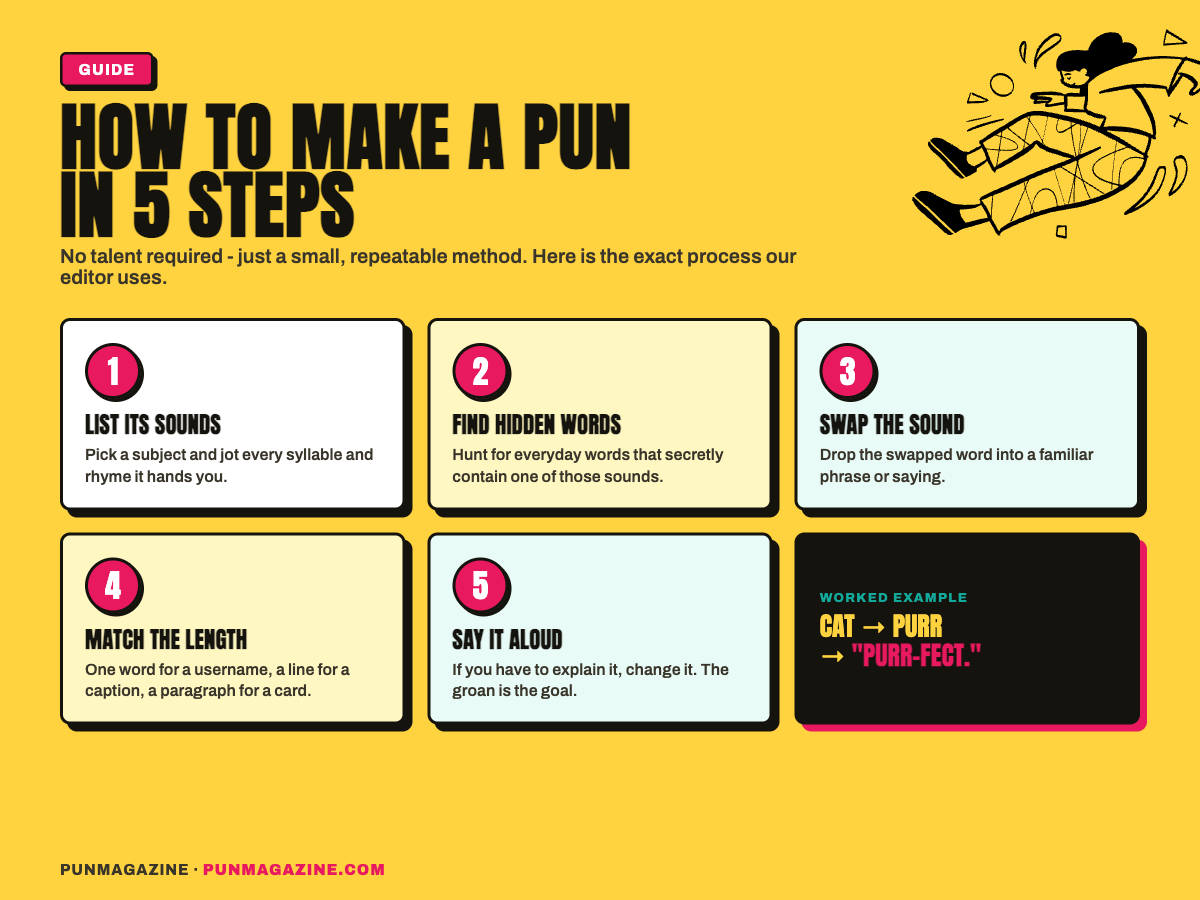
What a pun actually swaps
Before the steps, it helps to know exactly what raw material you are working with, because a pun is not built from ideas - it is built from sound. A pun swaps one chunk of sound for another chunk of sound that means something different, while keeping the sentence recognisable. That chunk can be three different sizes, and knowing which size you are reaching for makes the whole thing faster.
The smallest unit is a single sound or letter cluster, like turning the " pause " in a sentence into " paws " for a dog joke. The middle unit is a syllable, the little beat inside a word - the "purr" beat that lets "perfect" become "purr-fect", or the "bee" beat that turns "before" into "bee-fore". The largest unit is a whole word that happens to sound like another whole word, like "flour" and "flower", or "knight" and "night". Most puns you love live in the syllable range, because a swapped syllable is small enough to slip past the reader unnoticed and big enough to carry a clear second meaning. When you list your raw material in Step 1, you are really listing sounds, syllables and words all at once, then choosing whichever size drops most cleanly into a phrase people already know. For a fuller breakdown of the categories, our what is a pun explainer maps the formal types.
Step 1: Pick your subject and list its sounds
Every pun starts with the sounds a subject hands you for free, so the first move is never to think of a joke - it is to make an inventory. Write your subject at the top of a page, then list every syllable, rhyme, near-rhyme, associated word and stray sound it contains. Do not filter yet. A messy, generous list is worth more than a short clever one, because you cannot know in advance which sound will find a home in a phrase.
Take cat. Your list should sprawl: cat, purr, meow, paw, claw, fur, hiss, tail, whisker, feline, kitten, scratch, pounce, litter, mice, tabby. Now take bee. You get: bee, buzz, honey, hive, sting, wax, swarm, nectar, queen, comb, drone, pollen. Notice that the good sounds are not just the obvious ones. "Feline" and "hive" and "comb" are the workhorses because they hide inside longer everyday words. The longer your inventory, the more doorways you have into the next step, so spend a real minute here and aim for a dozen entries before you move on.
Step 2: Find everyday words that hide those sounds
Now you go hunting. Take each sound from your list and ask a single question: what common words or phrases already contain this sound, even loosely? This is the reverse of how we normally use language. Instead of starting from a meaning and reaching for a word, you start from a sound and reach for every word that carries it. The trick is to say the sound aloud and let ordinary vocabulary answer back.
The "purr" from cat hides inside per-fect, per-son, per-haps and pur-pose. The "paw" from cat hides inside paus-e and impor-tant if you stretch it. The "bee" from bee hides inside be-have, be-fore, may-be and un-be-lievable. The "hive" is one letter from "I have". Write these matches next to their sounds. You are looking specifically for words people say every single day, because a pun that hides inside a common word lands instantly, with no gap where the reader has to work out what you meant. If a hidden word is rare or technical, cross it off - it will only cause the pause that kills the joke.
Step 3: Swap the sound into a familiar phrase
A pun rarely lands as a lone word. It lands when the swapped word sits inside a phrase the reader already knows by heart, because the familiar phrase does the heavy lifting - the reader recognises the original in a split second and then feels the twist. So your third move is to take the everyday word you found and drop it into a cliche, idiom, saying, song title, film name or common sentence.
"Feeling fine" becomes feline fine. "For real" becomes fur real. "It was meant to be" becomes it was meant to bee. "Let it be" becomes let it bee. Cliches and idioms are goldmines precisely because they are worn smooth from overuse, so any small change to them jumps out. Keep a running list of stock phrases in your head - "the bees knees", "no big deal", "you have got to be kidding", "the best of both worlds" - and try your swapped word against each one until a phrase clicks. When the original phrase and the new meaning both make sense in the sentence, you have a pun.
Step 4: Match the length to the job
A pun is a tool, and like any tool it has to fit the job it is going to. The exact same idea can be delivered as one word, a short phrase, a full one-liner or a whole punny paragraph, and getting the length wrong is the difference between a caption that works and one that reads as clumsy. So before you write the final version, decide where it is going and size it accordingly.
For a username, a hashtag or a pet name, compress the pun to a single word - "purr-fect" or "meow-velous". For an Instagram caption, aim for a short sentence like "feeling feline fine today". For a greeting card or a text to a friend, a full one-liner earns its space. For a speech, a toast or a class of kids, you can string several puns into a paragraph and let them build. Every collection on this site is sorted by length for exactly this reason, so you can grab the size you need - browse the one-word entries in cat puns to see the shortest form, then scroll to the one-liners to watch the same subject stretch out.
Step 5: Read it aloud and cut the explanation
The final test is your ear, not your eye. A pun that looks fine on the page can collapse when spoken, because the sound similarity that carries the joke either survives out loud or it does not. So say your pun aloud, at normal speed, the way a stranger would read it. If the two meanings both arrive without you having to slow down or nudge them, it works. If you find yourself wanting to add "get it?" or a note explaining the link, the pun is not landing yet.
When a pun needs explaining, do not abandon it - repair it. Usually one of two things is wrong: the hidden sound is too buried, so swap in a closer match, or the host phrase is not familiar enough, so trade it for a more common one. Compare "a rye sense of humour" (clean, because "wry" and "rye" are near-identical and the phrase is everyday) with a strained version built on a rare word. The groan is the goal here: a good pun is understood a half-second before you consciously notice how silly it is, and that tiny delay is what makes people groan and remember. When it earns the groan without a footnote, it is finished.
The main pun techniques
The five steps are the process; these are the five moves you will actually make inside them. Almost every pun in English is one of these, and once you can name the technique you are using, you can reach for a different one the moment the first will not fit.
Homophone swap replaces a word with another that sounds identical but means something else: "flour" for "flower", or "sun" for "son", as in "the baker's son was a real ray of sunshine". Phrase swap takes a whole known phrase and bends one word of it, keeping the rhythm intact: "the bees knees", "it is a-boat time", "lettuce turnip the beet". Portmanteau blends two words into one new word that carries both meanings, like "purr-suasion", "choco-holic" or "meowntain". Near-rhyme swaps in a word that is close but not exact, letting the reader's ear bridge the small gap: "a rye sense of humour" for "wry", or "olive you" for "I love you". Add or remove a letter changes a single letter to reveal a new word hiding inside the old one: "a well-oiled machine" becoming a pun about "a well-boiled machine", or "un-bee-lievable" adding the extra "e". Try your raw material against each move in turn - one of the five almost always produces a clean swap.
Choosing the right length
Length is not just about where the pun goes; it changes how the joke feels, so it is worth treating as a creative choice rather than an afterthought. The same subject can be delivered at four different scales, and each scale has its own best use.
The one-word pun is pure compression, ideal for names, handles and labels: "purr-fect", "grate" (for cheese), "brew-tiful" (for coffee). It works because there is nowhere to hide - the whole joke arrives in a single beat. The short phrase gives the pun a tiny bit of context to breathe: "feline fine", "holy cow", "a latte love". It is the natural size for captions and product names. The one-liner is a full miniature joke with a setup and a payoff: "I am on a seafood diet - I see food and I eat it." It suits cards, texts and social posts where you have a whole sentence. The punny paragraph chains several puns around one theme so they compound, which is perfect for speeches, wedding toasts and captions with room to run. To feel the range, look at how one animal stretches from a single word to a one-liner in cat puns, then compare it with the food-themed rhythm of bread puns and the drink-shop patter of coffee puns, or browse the full library at all pun topics to see every length side by side.
Three worked examples
Reading the method is one thing; watching it run is another. Here are three subjects taken from a blank page to a finished line using the exact five steps, so you can see how the same machine produces very different jokes.
First, cat. Step 1, list the sounds: purr, meow, paw, claw, fur, feline, hiss, tail. Step 2, find hidden words: "purr" hides in per-fect, "feline" sounds like "feeling", "fur" sounds like "for", "paw" sits inside "pause". Step 3, swap into a phrase: "feeling fine" becomes feline fine, "for real" becomes fur real, "perfect" becomes purr-fect. Step 4, size it: "purr-fect" for a username, "feeling feline fine" for a caption. Step 5, say it aloud - all three land with no explaining, so they are done. Dozens more built the same way live in cat puns.
Second, bread. Step 1, sounds: loaf, dough, rye, roll, crust, knead, toast, crumb. Step 2, hidden words: "loaf" is one letter from "love", "rye" sounds like "wry", "knead" sounds like "need", "dough" hides in cash slang. Step 3, swap: "I love you" becomes I loaf you, "a wry sense of humour" becomes a rye sense of humour, "you need this" becomes you knead this. Step 4, size it: each is already a tidy short phrase, perfect for a card. Step 5, aloud: clean groans, no footnotes. Three finished puns in under a minute, and the full set is at bread puns. Third, coffee. Step 1, sounds: brew, bean, espresso, latte, mug, grind, roast, perk. Step 2, hidden words: "bean" sounds like "been", "latte" sounds like "a lot", "brew" hides in "brutal" and "beautiful", "espresso" hides "express". Step 3, swap: "I have been thinking about you a lot" becomes I have bean thinking about you a latte, "beautiful" becomes brew-tiful, "express yourself" becomes espresso yourself. Step 4, size it: "brew-tiful" for a mug, the "bean/latte" line for a caption. Step 5, aloud: they land, so ship them. See how far the bean goes at coffee puns.
Mistakes that kill a pun
Most failed puns fail for one of a few predictable reasons, and every one of them is fixable once you can name it. Run any pun that is not landing against this checklist before you give up on it.
- Forced: the swap is technically clever but the sentence around it is contorted to make it fit. If you had to bend the grammar or add an odd word just to reach the pun, the reader feels the strain. Fix it by finding a more natural host phrase.
- Needs explaining: if you want to add "get it?" or a parenthetical note, the sound is too buried or the phrase too obscure. Swap in a closer sound-alike or a more familiar phrase so the second meaning arrives on its own.
- Too obscure: the pun leans on a word, name or reference most people will not know. A pun is only as strong as the phrase it hides in, so if the host is niche, the joke dies for most of your audience. Trade it for something everyday.
- Mean-spirited: the pun works by punching down or landing an insult. Even a technically neat pun sours if it targets a person unkindly, and it undercuts the light, groan-and-grin mood that makes wordplay welcome. Keep the target the language itself, not a person.
How to get faster
The only real way to speed up is reps, because the five steps compress with practice until you run them almost without noticing. Pick a subject, set a timer, and write ten puns in one sitting. The first three will be slow and the last three will surprise you, and that is exactly the muscle you are building - the ability to move from a subject to a finished swap without stalling. Do this a few times a week on different subjects and you will start seeing puns in ordinary conversation, which is the sign the method has become instinct.
Two habits accelerate it further. First, keep a swipe file: a running note of stock phrases, idioms, song titles and film names you can raid for host phrases, plus any strong puns you meet in the wild so you can reverse-engineer how they were built. A big phrase bank turns Step 3 from a search into a quick scan. Second, when you are stuck for a starting sound, let a tool prime the pump - our free pun generator mixes a batch of swaps from any word in seconds, giving you raw candidates you can then refine by ear using Step 5. Pair the generator with the finished sets on our topic pages and the greatest hits in the best puns of all time, and you will always have both raw material to shape and polished examples to learn from.

Ex-greeting-card copywriter turned full-time pun curator. Polly writes, groan-tests and reviews every list on PunMagazine - if a pun lands before you notice it, it earns its place.
More about PollyHow to make a pun FAQ
How do you make a simple pun?
List the sounds in your subject word, find an everyday word that hides one of those sounds, and swap it into a familiar phrase. For example, "purr" hides in "perfect", giving you "purr-fect", and "feline" sounds like "feeling", giving you "feline fine".
What are the five steps to writing a pun?
One, pick a subject and list all its sounds. Two, find everyday words that hide those sounds. Three, swap the sound into a familiar phrase. Four, match the length to where it will be used. Five, read it aloud and cut anything that needs explaining.
What makes a pun good?
A good pun is understood instantly with no explanation needed, swaps a sound into a phrase the reader already knows, and stays family-friendly. If it earns a groan on the first read, it is working.
What are the main pun techniques?
The five core moves are the homophone swap (flour for flower), the phrase swap (bending one word of a known phrase), the portmanteau (blending two words like purr-suasion), the near-rhyme (rye for wry) and adding or removing a single letter (un-bee-lievable).
Why does my pun fall flat?
Usually one of four reasons: it is forced and the sentence is contorted to fit, it needs explaining because the sound is too buried, it is too obscure and leans on a phrase most people do not know, or it is mean-spirited. Fix the host phrase or pick a closer sound-alike.
How do I get better at making puns fast?
Practise in batches - pick a subject and write ten in one sitting - and keep a swipe file of stock phrases and idioms to raid for host phrases. When you are stuck for a starting sound, run the word through a pun generator to get raw candidates, then refine them by ear.
Where can I find pun examples to learn from?
Every topic page on PunMagazine is a worked example. Start with sound-rich subjects like cat, bread or coffee puns and reverse-engineer how each line is built, or read our roundup of the best puns of all time to study what makes the strongest ones land.
What is the difference between a pun and a regular joke?
A regular joke is usually built on a situation or a surprising idea, while a pun is built on a word - it exploits the fact that words can sound alike or carry two meanings, so a single phrase points in two directions at once and makes you groan rather than laugh.