What Is a Pun? Types, Examples and Why They Work
A pun is a joke built on a word, not on a situation. Where most jokes need a setup, a scene and a punchline, a pun needs only a single word that happens to sound like another word or carry more than one meaning. That one word does all the work, pointing the sentence in two directions at the same time so the reader hears both readings at once. It is the most compact form of humour we have, which is exactly why it turns up on greeting cards, cafe chalkboards, pet names and newspaper headlines. This guide gives you a plain-English definition, the proper name for the device, the four main types with examples you can spot in the wild, how a pun differs from its wordplay cousins, a short history stretching from ancient scribes to the modern dad joke, and the small piece of brain science that explains why a really good pun makes us groan instead of laugh.
The definition
A pun (also called paronomasia) is a form of wordplay that exploits either a word's multiple meanings or its similarity in sound to another word, in order to create a second, usually humorous, layer of meaning. Put plainly: a pun swaps a normal word for a sound-alike or double-meaning word so the sentence works two ways at once. When you say "I am feeling feline fine", the ear hears "feeling fine" and the mind also catches the cat, and both readings sit there together. The technical term, paronomasia, comes from Greek. It is built from para, meaning beside or alongside, and onoma, meaning name or word - so paronomasia literally describes one word set alongside another, which is a neat picture of what a pun does. The Romans borrowed the idea wholesale, and the plain English word "pun" most likely shortened from an older habit of calling this device a play on the point or fine tip of a phrase. Whatever the etymology, the mechanism has not changed in thousands of years: take a word, find its sound-twin or its hidden second sense, and let the two meanings collide.
The four types of puns
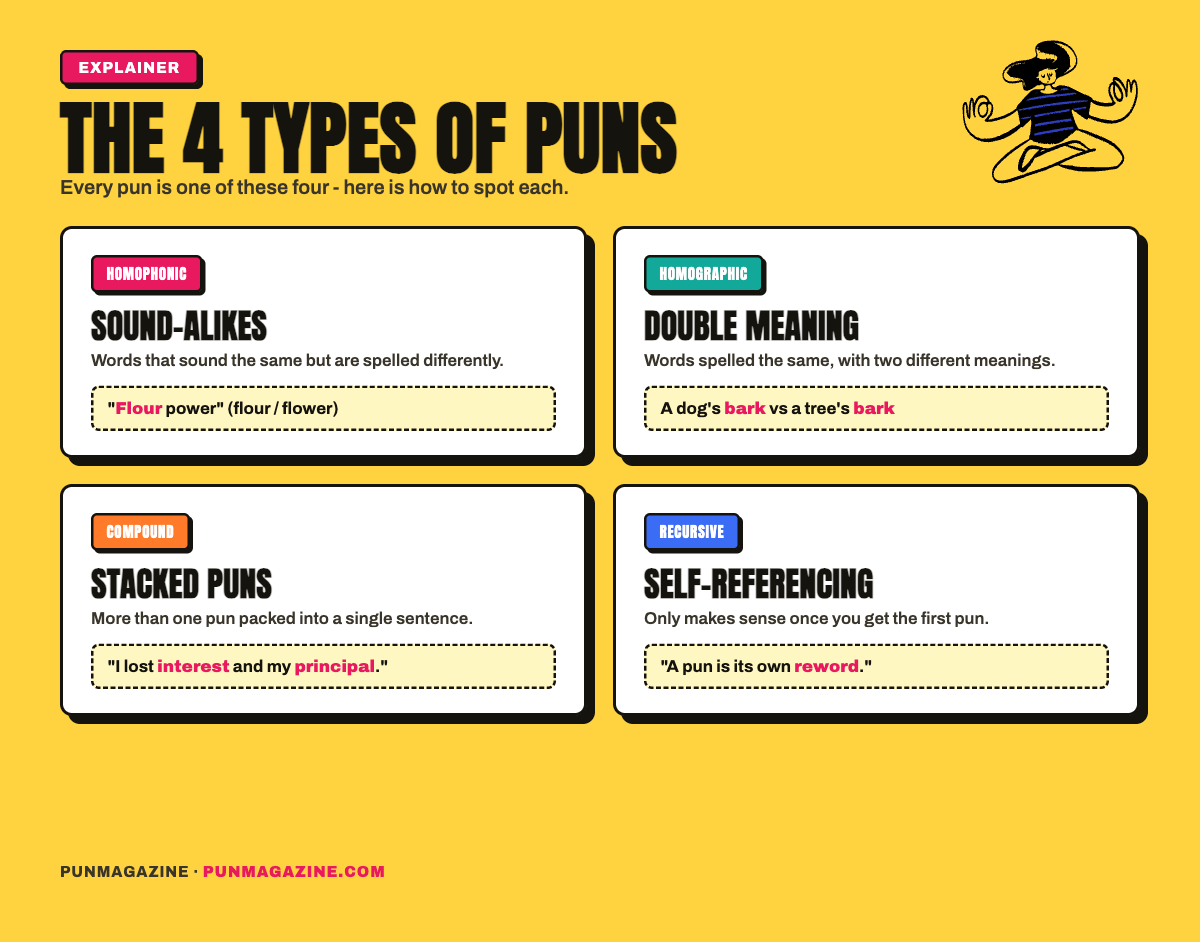
Almost every pun you will ever meet falls into one of four buckets. Learning to name them is the quickest way to understand how the trick is built, and once you can name a type you can start building your own. Here are the four, running from the most common to the most self-aware. If you want a dozen worked cases of each rather than one, see pun examples.
Homophonic puns
A homophonic pun uses two words that sound the same but are spelled differently and mean different things - homophones. The classic pair is flour and flower, which is why a baker can be told to "say it with flours". You will also hear knight and night, sun and son, or whether and weather doing the same job. To spot one, listen rather than read: if the joke only works out loud, and swapping the spelling changes the meaning, it is homophonic. These are the friendliest puns to write, because English is stuffed with words that sound alike, so a matching pair is rarely far away.
Homographic puns
A homographic pun uses one spelling that carries two meanings - a homograph. Here the word does not change at all; the sentence simply lets both senses fire. A dog can give a bark that matches the bark of the tree it is tied to. A person can be left with nothing left to say. You can pull down from a duck but you get down off a horse. To spot one, look for a single word that could be swapped for two completely different definitions without changing a single letter. Because the spelling stays put, homographic puns often read as a touch cleverer and land a beat slower than homophonic ones.
Compound puns
A compound pun stacks two or more puns into a single sentence, so the groans arrive in quick succession. "I used to be a banker, but I lost interest and my principal" plays on interest (curiosity versus finance) and principal (a sum of money versus a school head), both at once. A tale about someone who could not run to catch the bus, so he made a few adjustments and it all worked out, layers several senses of working out. To spot a compound pun, count the joke words: if there is more than one double meaning doing separate work in the same line, it is compound. These reward a second read, because the first pun can distract you from the second.
Recursive puns
A recursive pun is the show-off of the family: it only makes sense once you already understand the first half, because the joke refers back to itself. The famous example, "a recursive pun is its own reword", plays on reword and reward while quietly describing exactly what a recursive pun does. Another favourite folds its own definition into the gag: "infinity is not in finity". To spot one, notice whether the pun is commenting on itself or on the very idea of punning. Recursive puns are rare and a little smug, but landing one feels like finishing a crossword in ink.
- Homophonic: "The baker said it with flours." (flour / flower)
- Homophonic: "A knight only works the night shift." (knight / night)
- Homographic: "The dog gave a bark that matched the tree bark."
- Homographic: "I was left with nothing left to say."
- Compound: "I used to be a banker, but I lost interest and my principal."
- Recursive: "A recursive pun is its own reword."
Puns versus other wordplay
A pun is one member of a large family of word tricks, and the members are easy to mix up. Here is how a pun differs from its five closest relatives, each with an example. A spoonerism swaps the opening sounds of two words, so "a well-oiled bicycle" becomes "a well-boiled icicle"; it is an accident of sound rather than a second meaning, which is what separates it from a pun - a spoonerism scrambles, a pun doubles. A malapropism replaces a word with a similar-sounding wrong one, as when a character calls himself "the very pineapple of politeness" instead of pinnacle; the humour comes from the mistake, whereas a pun is deliberate and knows exactly what it is doing. A double entendre is a phrase that carries two meanings where one is usually innocent and the other cheeky; it overlaps with the pun, but it leans on suggestion and context rather than a sound-alike word, and it can exist with no wordplay at all. A portmanteau fuses two words into one new word, like "brunch" from breakfast and lunch or "smog" from smoke and fog; it builds a fresh word rather than exploiting an existing double meaning, so it creates where a pun borrows. An oxymoron pairs two contradictory words on purpose, such as "deafening silence" or "bittersweet"; it plays on meaning like a pun, but through contradiction rather than similarity, joining opposites instead of sound-twins. Keep the test simple: if the joke turns on one word meaning or sounding like two things, it is a pun; if it scrambles, mistakes, suggests, fuses or contradicts, it is one of the cousins. Each of those cousins is covered properly, with examples, in our guide to plays on words.
A short history of the pun
Puns are about as old as writing itself. Ancient Egyptian scribes buried sound-play in hieroglyphs and temple inscriptions, and the writers of the Hebrew Bible used puns on names to hint at a character's fate long before anyone thought to call it a literary device. The Greeks and Romans treated wordplay as a mark of wit rather than a groan-worthy habit, and orators used it to score points in the forum. The golden age in English arrived with the Elizabethans, and no one loved a pun more than Shakespeare, who packed thousands of them into his plays. A dying Mercutio in Romeo and Juliet manages one last joke - "ask for me tomorrow and you shall find me a grave man" - turning grave from serious into tomb with his final breath. For Shakespeare puns were not lowbrow at all; they were a display of quick thinking that educated audiences prized. The Victorians kept the flame alive in a more genteel way, filling parlour games, comic magazines and after-dinner speeches with elaborate wordplay, though a growing band of critics began sniffing that puns were rather beneath a serious mind. That snobbery never quite killed them. In our own era the pun has found a comfortable home in the dad joke, the deliberately corny, family-friendly one-liner delivered with a straight face and a hopeful raised eyebrow. From temple walls to the breakfast table, the pun has survived every attempt to retire it, which tells you something about how deeply the pleasure of a double meaning is wired into us. The full story, from the rebus principle in hieroglyphs through the Elizabethan stage to the eighteenth-century critics who talked the pun down, is in our history of the pun.
Why puns make us groan
A laugh comes from surprise; a groan comes from recognition. The idea psychologists reach for here is dual activation. When you hear a pun, the ambiguous word briefly switches on both of its meanings in your mind at the same time - both readings are live at once before the sensible one would normally win. For a fraction of a second your brain holds two interpretations side by side, notices that they both fit, and registers the deliberate collision. That flicker of extra processing, the tiny mental double-take, is the groan. It is the sound of a brain saying "I see what you did there, and I cannot believe I did not see it coming". Crucially, the groan is not a sign the joke failed. A pun that slides past with no groan at all has usually failed to make both meanings fire. The groan is the receipt that proves the wordplay was received, so when someone rolls their eyes and exhales at your best line, take the bow. For the step-by-step method behind writing lines that trigger exactly this reaction, see our guide on how to make a pun.
Is the pun really the lowest form of humour?
You have probably heard that the pun is the lowest form of wit. The line has been repeated so often that many people accept it as settled fact, but it is worth pushing back. The fuller version of the sentiment runs "the pun is the lowest form of wit, which is why it is the foundation of all humour", and that second half quietly flips the insult into a compliment. A pun demands a real command of language: you have to hold several meanings of a word in your head at once, judge which crowd will catch the reference, and land it in the fewest possible syllables. That is not laziness; it is compression, and compression is hard. Shakespeare, John Donne and James Joyce were all shameless punsters, and nobody accuses them of low wit. The honest truth is that a bad pun is lazy and a good pun is a small feat of engineering, exactly like every other kind of joke. The device is not the problem, the craft is. So judge the pun, not puns. If you want to see the form at its sharpest, we have ranked our favourites in the best puns of all time.
Where puns show up (and why they are useful)
Puns thrive wherever copy has to be short, memorable and warm. Think Instagram captions, greeting cards, pet and business names, pub chalkboards, newspaper headlines, wedding speeches, classroom jokes and brand taglines. The reason is practical: a pun compresses a whole extra layer of meaning into one familiar word, so it earns attention and sticks in memory without asking the reader to do any work. A cafe called Java the Hut, a hair salon called Curl Up and Dye, or a plumber promising "a flush of quality", all trade on the same instant double take. That usefulness is exactly why we sort every collection on this site by the job it does - captions, one-word names, kids' jokes and one-liners - so you can grab the right size and tone in seconds. Browse the full library at all pun topics, warm up on sound-rich subjects like cat puns, egg puns or bee puns, and if you would rather build your own from any word, our free pun generator will mix a batch in a click. Once you have read a few hundred, spotting the four types becomes second nature, and you will never look at a chalkboard the same way again.

Ex-greeting-card copywriter turned full-time pun curator. Polly writes, groan-tests and reviews every list on PunMagazine - if a pun lands before you notice it, it earns its place.
More about PollyWhat is a pun? FAQ
What is a pun in simple terms?
A pun is a joke that plays on a word. It swaps in a word that sounds like another or has two meanings, so a single phrase works two ways at once and points in two directions at the same time.
What does pun mean and where does the word come from?
A pun is wordplay that uses a word's double meaning or its sound-alike twin for humorous effect. Its formal name, paronomasia, comes from the Greek para (beside) and onoma (name), literally one word set alongside another.
What are the four types of puns?
Homophonic (same sound, different spelling, like flour and flower), homographic (same spelling, two meanings, like tree bark and a dog's bark), compound (several puns stacked in one line) and recursive (only makes sense once you get the first pun).
Can you give some easy pun examples?
Sure. "The baker said it with flours" is homophonic, "I was left with nothing left to say" is homographic, and "a recursive pun is its own reword" is recursive. Any topic page on this site is full of worked examples.
Why do puns make you groan instead of laugh?
Because a groan comes from recognition, not surprise. Both meanings of the pun word switch on at once, your brain does a tiny double take, and that "I should have seen it coming" feeling comes out as a groan. It means the pun landed.
How is a pun different from a spoonerism or a malapropism?
A pun doubles a word's meaning on purpose. A spoonerism swaps the opening sounds of two words by accident (a well-boiled icicle), and a malapropism uses a wrong but similar-sounding word by mistake (the pineapple of politeness). Only the pun is a deliberate double meaning.
Is the pun really the lowest form of humour?
The famous put-down is only half the thought, which ends by calling the pun the foundation of all humour. A good pun takes real command of language and tight compression, so it is a small feat of craft rather than laziness.