No Pun Intended: Meaning, Origin and Use
"No pun intended" is the small apology people attach to a sentence the moment they hear a second meaning arrive in it. It is one of the most-used stock phrases in English and one of the least examined, partly because almost everybody who says it is fibbing slightly. This guide covers what the phrase means, where it came from, how to punctuate it, when it helps a sentence and when it quietly ruins one, and what to use instead when you would rather not draw attention to the joke at all. If you are here because you want to understand the device rather than the disclaimer, our guide on <a href="/guides/what-is-a-pun">what a pun is</a> covers the mechanism, and <a href="/guides/pun-examples">pun examples</a> supplies ninety or so worked cases.
What does "no pun intended" mean?
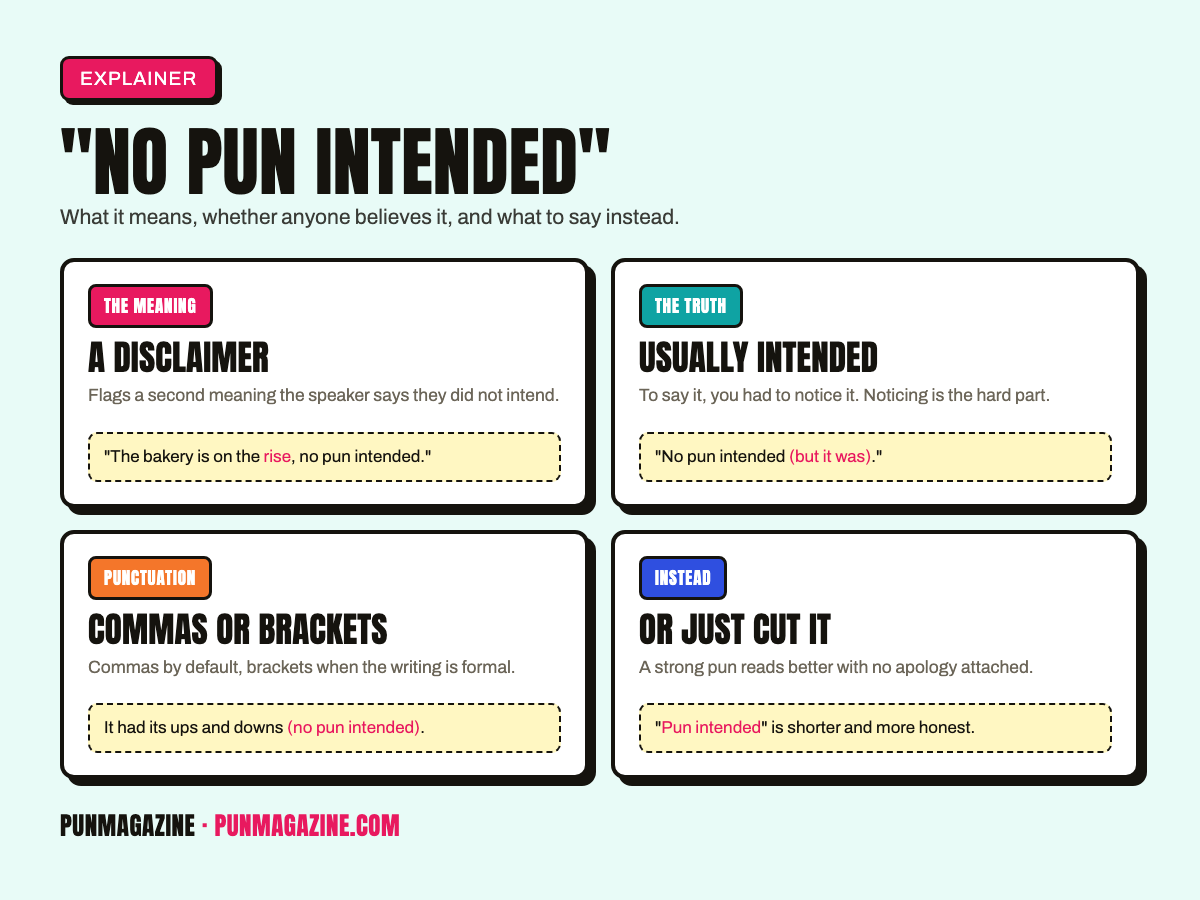
"No pun intended" means the speaker has noticed that a word in their own sentence carries a second, usually humorous meaning, and wants you to know they did not put it there on purpose. It is a disclaimer, not a joke. Say "the meeting about the bakery went badly, no pun intended" and you are flagging that you heard "went badly" brush against the bread and you would rather not be credited with the gag. The phrase performs two jobs at once: it shows you are paying attention to your own language, which is a small competence signal, and it distances you from a joke that might be thought too easy. Both jobs are social rather than grammatical, which is why the phrase can be deleted from almost any sentence without changing the sentence's meaning at all.
Where the phrase comes from
The phrase is younger than it sounds. Puns themselves are ancient, but the habit of apologising for one in writing belongs to the period when punning fell out of critical favour. Through the seventeenth and eighteenth centuries the pun slid from being a mark of wit, which is how the Elizabethans treated it, to being something a serious writer was expected to be above. Once the device carried a whiff of the lowbrow, writers needed a way to use a double meaning and simultaneously deny credit for it, and the parenthetical disclaimer is exactly that device. The modern fixed form, with "no" and "intended" bracketing the word "pun", settles into common written English during the nineteenth century and becomes conversational filler in the twentieth. The tell is that it survives at all: a phrase whose only function is to disown a joke could only take hold in a culture that had decided the joke was slightly embarrassing.
Was the pun really unintended?
Usually not, and everyone knows it. There is a reasonable case that most uses of "no pun intended" are what linguists would call a face-saving move rather than a statement of fact. If a pun were genuinely accidental, the speaker would have to notice it, which requires the same attention that would have produced it deliberately. The phrase therefore tends to mean something closer to "I am aware this reads two ways, please credit me for spotting it but do not judge me for enjoying it". That is not dishonesty so much as etiquette. It lets a speaker have the joke and the disclaimer at the same time, which is why the honest variants below exist and why some writers find the whole construction irritating.
When to use it, and when it weakens the sentence
The phrase earns its place when the second meaning would genuinely distract from something serious. In a condolence message, a medical explanation, a legal note or a piece of bad news, a stray double meaning can read as flippancy, and flagging it costs you four words and buys you clarity of tone. It also helps in writing that will be read by people who do not share your first language, where an unmarked double meaning can simply confuse.
It weakens a sentence in three common situations. First, when the pun is good: pointing at it is the written equivalent of laughing at your own joke, and a strong line does better standing alone. Second, when the pun is invisible: readers who had not noticed the second meaning now have to go back and look for it, and the sentence has spent four words to create a distraction it then apologises for. Third, in anything short. A caption, a headline, a subject line or a text message has no room for a disclaimer, and adding one makes the whole thing read as hesitant. The rule of thumb: if you are proud of the pun, cut the disclaimer. If you are worried about the tone, keep it.
"Pun intended" and its variants
The mirror phrase, "pun intended", does the opposite job: it claims credit and makes sure a reader who might have skimmed past the second meaning goes back for it. It reads as more confident than "no pun intended" and is the better choice when the wordplay is the point of the sentence rather than an accident inside it. From there English has produced a small family of escalations, each a little more pleased with itself:
- "Pun intended" - claims the joke plainly.
- "Pun very much intended" - claims it and enjoys it.
- "Pun absolutely intended" - the same, with the volume up.
- "Pun fully intended" - slightly drier, common in British usage.
- "No pun intended (but it was)" - the honest version, and the funniest of the set.
- "Sorry, not sorry" - the general-purpose modern cousin, not specific to wordplay.
There is also the deadpan option of saying nothing at all, which experienced punners tend to prefer. A pun delivered without comment and without a pause is the whole basis of the dad joke, and our corny puns collection is built on that delivery.
How to punctuate it
"No pun intended" is a parenthetical aside, so it takes the punctuation any aside would take, and you have three options. Commas are the default and the least intrusive: the diver said the job had its ups and downs, no pun intended. Brackets are the quietest and are the right choice in formal writing, because they signal clearly that the aside is outside the sentence proper: the diver said the job had its ups and downs (no pun intended). Dashes are the loudest and give the aside the most emphasis, which is usually the opposite of what a disclaimer wants, so use them sparingly.
Two smaller points. The phrase does not take a capital letter unless it begins a sentence, and it does not need quotation marks around it when used normally, only when you are discussing the phrase itself, as this guide is. Placement is almost always immediately after the offending clause rather than at the end of a long sentence, because a reader who has travelled thirty words past the pun will have to reverse to find it.
Examples in a sentence
- "The bakery has been on the rise lately, no pun intended."
- "He was fired from the firework factory, no pun intended."
- "Our fishing club has been struggling to attract new members, no pun intended."
- "The tailor said the meeting was a bit of a stitch-up (no pun intended)."
- "She has been feeling drained since starting at the power station, no pun intended."
- "Sales at the mattress shop are flat, pun very much intended."
Read those again without the disclaimer. Four of the six are stronger for losing it, which is a fair sample of how the phrase performs in the wild.
What to say instead
If you want the effect without the cliche, you have a few options. You can simply delete it, which works more often than people expect. You can mark the word rather than the sentence, putting the punning word in italics so an attentive reader catches it and a hurried one is not slowed down. You can use "so to speak" or "if you will", both of which flag a double meaning without naming it as a pun. In speech you can do nothing at all and let the pause do the work. And if the wordplay was deliberate and you would like credit, "pun intended" is shorter, more honest and reads better than the negative form.
Why the phrase annoys some people
Style guides and editors tend to dislike "no pun intended" for the same reason they dislike "literally" used for emphasis: it is a phrase that mostly signals self-consciousness. The objection is not that puns are bad, it is that the disclaimer asks the reader to admire a joke and forgive it in the same breath, which is a lot to ask of four words. There is also the practical point that it dates writing. Stock phrases attach themselves to a period, and this one is now firmly associated with a particular register of chatty online prose. None of that means you should never use it. It means the default should be to leave it out, and to add it only when the tone genuinely needs protecting.

Ex-greeting-card copywriter turned full-time pun curator. Polly writes, groan-tests and reviews every list on PunMagazine - if a pun lands before you notice it, it earns its place.
More about PollyNo pun intended FAQ
What does "no pun intended" mean?
It means the speaker has noticed that a word in their own sentence carries a second, usually humorous meaning, and wants you to know they did not put it there deliberately. It is a disclaimer rather than a joke, and it can be deleted from almost any sentence without changing the meaning.
Is the pun ever actually unintended?
Rarely. To say the phrase you have to notice the double meaning, which takes the same attention that would have produced it on purpose. In practice it usually means "I know this reads two ways, credit me for spotting it but do not judge me for enjoying it".
How do you punctuate "no pun intended"?
As a parenthetical aside, using commas by default, brackets in formal writing, and dashes only when you want to emphasise it, which a disclaimer usually does not. Place it immediately after the clause containing the pun, not at the end of a long sentence.
What is the difference between "no pun intended" and "pun intended"?
"No pun intended" disowns the joke; "pun intended" claims it and makes sure the reader goes back for the second meaning. Use the second when the wordplay is the point of the sentence rather than an accident inside it.
What can I say instead of "no pun intended"?
Delete it, italicise the punning word so attentive readers catch it, or use "so to speak" or "if you will". If the wordplay was deliberate, "pun intended" is shorter and more honest.
Should I use "no pun intended" in formal writing?
Sparingly, and in brackets rather than commas. It earns its place when a stray double meaning would read as flippant in a serious context. Elsewhere the default should be to leave it out.