Play on Words: Every Type, with Examples
"Play on words" is the everyday name for a whole family of tricks, and the pun is only the most famous member. Sitting alongside it are the spoonerism, the malapropism, the double entendre, the portmanteau, the oxymoron and the anagram, and they are constantly mistaken for one another because they all involve bending a word out of its ordinary shape. They are not the same device, though, and knowing which one you are looking at is the difference between copying a trick and understanding it. This guide defines the phrase, settles the question of whether a play on words is the same thing as a pun, and then works through each type with examples. For the pun specifically, our guide on <a href="/guides/what-is-a-pun">what a pun is</a> goes deeper, and <a href="/guides/pun-examples">pun examples</a> supplies the volume.
What does "play on words" mean?
A play on words is any deliberate use of a word's sound, spelling or multiple meanings to produce an effect beyond its plain sense. The key word is deliberate. Language throws up accidental double meanings constantly and we mostly filter them out without noticing; a play on words is what happens when a writer or speaker notices one and decides to use it. The effect is usually humour, but not always. It can be emphasis, memorability, elegance or concision, which is why plays on words turn up as often in advertising slogans, brand names, political speeches and newspaper headlines as they do in jokes.
What all the types share is a single word doing more than one job. What separates them is how: some swap a word for its sound-twin, some fuse two words, some rely on a word already having two senses, and one of them (the malapropism) works only because the speaker got it wrong.
Is a play on words the same as a pun?
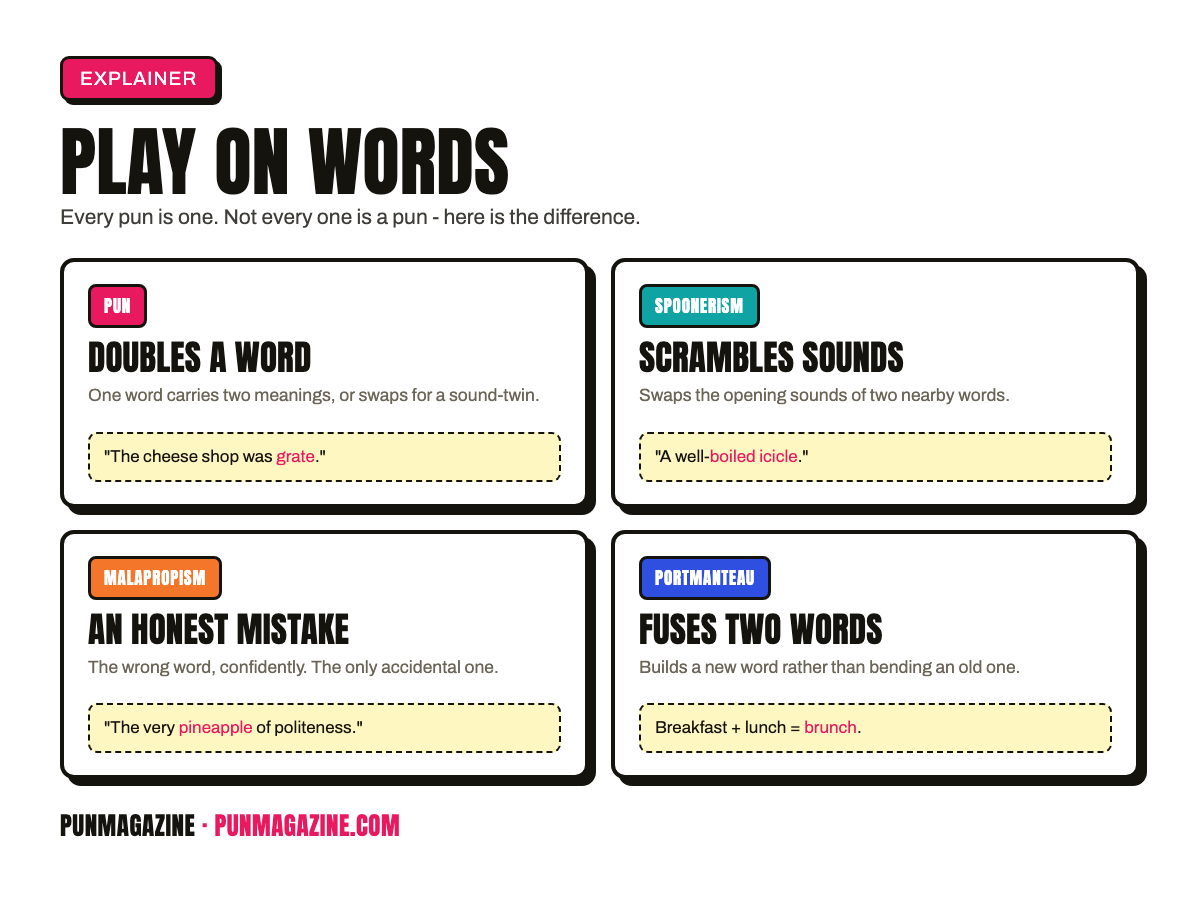
Not quite, and the relationship is worth getting right: every pun is a play on words, but not every play on words is a pun. "Play on words" is the umbrella term for the whole category. "Pun" is one specific member of it, defined by exploiting either a word's double meaning or its similarity in sound to another word, so that a phrase reads two ways at once.
A useful test. If the joke turns on one word meaning or sounding like two things at the same time, it is a pun. If it scrambles sounds between words, fuses two words into a new one, joins two contradictory words, or rearranges letters, it is a play on words but not a pun. In casual speech people use the two phrases interchangeably and nobody minds. In writing about language they are worth keeping apart, because the mechanisms genuinely differ.
The main types of wordplay
Here are the eight you will actually meet, with the mechanism and an example for each. They are ordered roughly by how close they sit to the pun.
Puns
The core device: one word carries two meanings, or is swapped for a sound-alike, so the sentence works two ways at once. "The baker said it with flours" plays on flour and flower. "I was left with nothing left to say" uses one spelling with two senses. English divides puns into four types, homophonic, homographic, compound and recursive, all covered in the pun guide.
Spoonerisms
A spoonerism swaps the opening sounds of two nearby words, so "a well-oiled bicycle" becomes "a well-boiled icicle". The name comes from William Archibald Spooner, an Oxford don who was famous for producing them, though a fair number of the ones attributed to him were almost certainly invented by students. The distinction from a pun is clean: a spoonerism scrambles, a pun doubles. There is no second meaning being exploited, just two sounds trading places, and the humour comes from the wreckage.
Classic examples: "you have hissed all my mystery lectures" for "missed all my history lectures", "three cheers for our queer old dean" for "dear old queen", and "a blushing crow" for "a crushing blow".
Malapropisms
A malapropism replaces a word with a similar-sounding wrong one, and the humour is entirely in the mistake. The name comes from Mrs Malaprop in Sheridan's play The Rivals, who describes someone as "the very pineapple of politeness" when she means pinnacle. This is the one type in the family where the speaker is not in on it. A pun is deliberate and knows exactly what it is doing; a malapropism is a person confidently reaching for a word and missing.
Other examples: "he is the very reverse of a gentleman" for reverse of what was meant, "dance a flamingo" for flamenco, and "for all intensive purposes" for "for all intents and purposes", which is now so common it has almost stopped being a mistake.
Double entendres
A double entendre is a phrase that carries two meanings where one is innocent and the other risque. It overlaps heavily with the pun, and many double entendres are puns, but the category is defined by the content of the second meaning rather than by the mechanism. It also does not need any wordplay at all: a perfectly ordinary sentence can be a double entendre if the context supplies the second reading. The phrase itself is odd, incidentally, in that it is not really current French; it is an English borrowing that has drifted from its source.
Portmanteaus
A portmanteau fuses two words into one new word: brunch from breakfast and lunch, smog from smoke and fog, motel from motor and hotel, podcast from iPod and broadcast. Lewis Carroll coined the term in Through the Looking-Glass, explaining that in a word like slithy there are "two meanings packed up into one word". The difference from a pun is that a portmanteau creates where a pun borrows: it builds a fresh word rather than exploiting the double life of an existing one. Brand names lean on this constantly.
Oxymorons
An oxymoron pairs two contradictory words on purpose: deafening silence, bittersweet, original copy, seriously funny. Like a pun it plays on meaning, but through contradiction rather than similarity, joining opposites rather than sound-twins. Note that an oxymoron is not the same as a paradox: an oxymoron is a two-word contradiction, a paradox is a whole statement that contradicts itself.
Anagrams and palindromes
An anagram rearranges the letters of a word or phrase into another: listen and silent, the eyes and they see. A palindrome reads the same in both directions: racecar, or the sentence "a man, a plan, a canal: Panama". Both are wordplay by any reasonable definition, and neither is a pun, because nothing is carrying two meanings at once. They belong to the puzzle end of the family rather than the joke end, which is why they turn up in crosswords more often than in comedy.
Homonym and homophone jokes
Strictly these are the raw material rather than a separate device. A homophone is two words that sound the same and are spelled differently (flour, flower). A homograph is one spelling with two meanings (bark, bark). A homonym is the loose everyday term covering both. Jokes built on them are simply puns, but the terminology comes up so often in schoolwork that it is worth knowing which word names which thing.
Play on words examples
- Pun: "The cheese shop was grate."
- Spoonerism: "You have hissed all my mystery lectures."
- Malapropism: "He is the very pineapple of politeness."
- Double entendre: "The fisherman said his rod had never let him down."
- Portmanteau: "Brunch", "smog", "podcast", "hangry".
- Oxymoron: "A deafening silence fell over the room."
- Anagram: "Listen" rearranges into "silent".
- Palindrome: "A man, a plan, a canal: Panama."
Read down that list and the family resemblance is obvious, but so are the differences. Only the first and the fourth involve a word meaning two things at once. The others bend language in ways that are related but genuinely distinct.
Where you will see plays on words
Anywhere space is tight and memorability matters. Advertising slogans and brand names use portmanteaus and puns because a fused or doubled word does the work of a sentence. Newspaper headlines, particularly in the British tabloids, have made punning headlines close to an art form. Business names run on them: hair salons, fish and chip shops and cafes are the three trades most likely to be trading under a play on words. Beyond commerce, they carry real weight in poetry, where a double meaning can hold two readings of a line in tension, and in political rhetoric, where a memorable phrase outlives the argument it was made in.
How to write a play on words
Start from the phrase, not the joke. Almost every successful play on words is a familiar phrase with one element altered, and the familiarity is doing more work than the alteration. So collect host phrases first: idioms, film titles, song lyrics, proverbs, the ordinary things people say. Then take your subject and list the words and sounds associated with it. Run the two lists against each other and look for a collision.
From there the type mostly picks itself. If the sound match is close, you have a pun. If two of your subject words want to fuse, you have a portmanteau. If the phrase has an innocent and a cheeky reading, you have a double entendre and a decision to make about your audience. The step-by-step version of this method is in how to make a pun, and if you would rather have one built for you, the generator will take any word.

Ex-greeting-card copywriter turned full-time pun curator. Polly writes, groan-tests and reviews every list on PunMagazine - if a pun lands before you notice it, it earns its place.
More about PollyPlay on words FAQ
What is a play on words?
Any deliberate use of a word's sound, spelling or multiple meanings to produce an effect beyond its plain sense. It is the umbrella term for a family of devices including puns, spoonerisms, malapropisms, double entendres, portmanteaus, oxymorons and anagrams.
Is a play on words the same as a pun?
Every pun is a play on words, but not every play on words is a pun. A pun specifically exploits a word's double meaning or its sound-alike twin. Scrambling sounds, fusing two words or joining opposites are all plays on words that are not puns.
What is the difference between a pun and a spoonerism?
A pun doubles a word's meaning on purpose, so a phrase reads two ways at once. A spoonerism swaps the opening sounds of two nearby words, as in "a well-boiled icicle" for "a well-oiled bicycle". A spoonerism scrambles; a pun doubles.
What is the difference between a pun and a malapropism?
Intent. A pun is deliberate and knows exactly what it is doing. A malapropism is a genuine mistake, a speaker reaching for a word and landing on a similar-sounding wrong one, as in "the very pineapple of politeness".
What are the main types of wordplay?
Puns, spoonerisms, malapropisms, double entendres, portmanteaus, oxymorons, and anagrams or palindromes. The first four bend meaning, the portmanteau builds a new word, the oxymoron joins opposites, and the last pair rearrange letters.
What is a portmanteau word?
A word made by fusing two others, such as brunch from breakfast and lunch, or smog from smoke and fog. Lewis Carroll coined the term, describing two meanings packed up into one word. Unlike a pun it creates a new word rather than exploiting an existing double meaning.