Pun Examples: 90+ by Type, with Explanations
Most people do not need a pun explained to them, they need to see enough of them in one place that the pattern becomes obvious. That is what this page is for. Below are more than ninety worked examples, sorted first by the four types of pun and then by the places puns actually turn up: adverts, headlines, business names, pet names and jokes for children. Each group opens with a plain description of the mechanism and closes with a note on why those particular lines land, because the fastest way to start writing your own is to see the same trick performed a dozen times in a row. If you want the formal definitions first, the <a href="/guides/what-is-a-pun">guide to what a pun is</a> covers the terminology. If you want the method rather than the examples, <a href="/guides/how-to-make-a-pun">how to make a pun</a> walks through it in five steps. Everything here is clean and free to use.
What is an example of a pun?
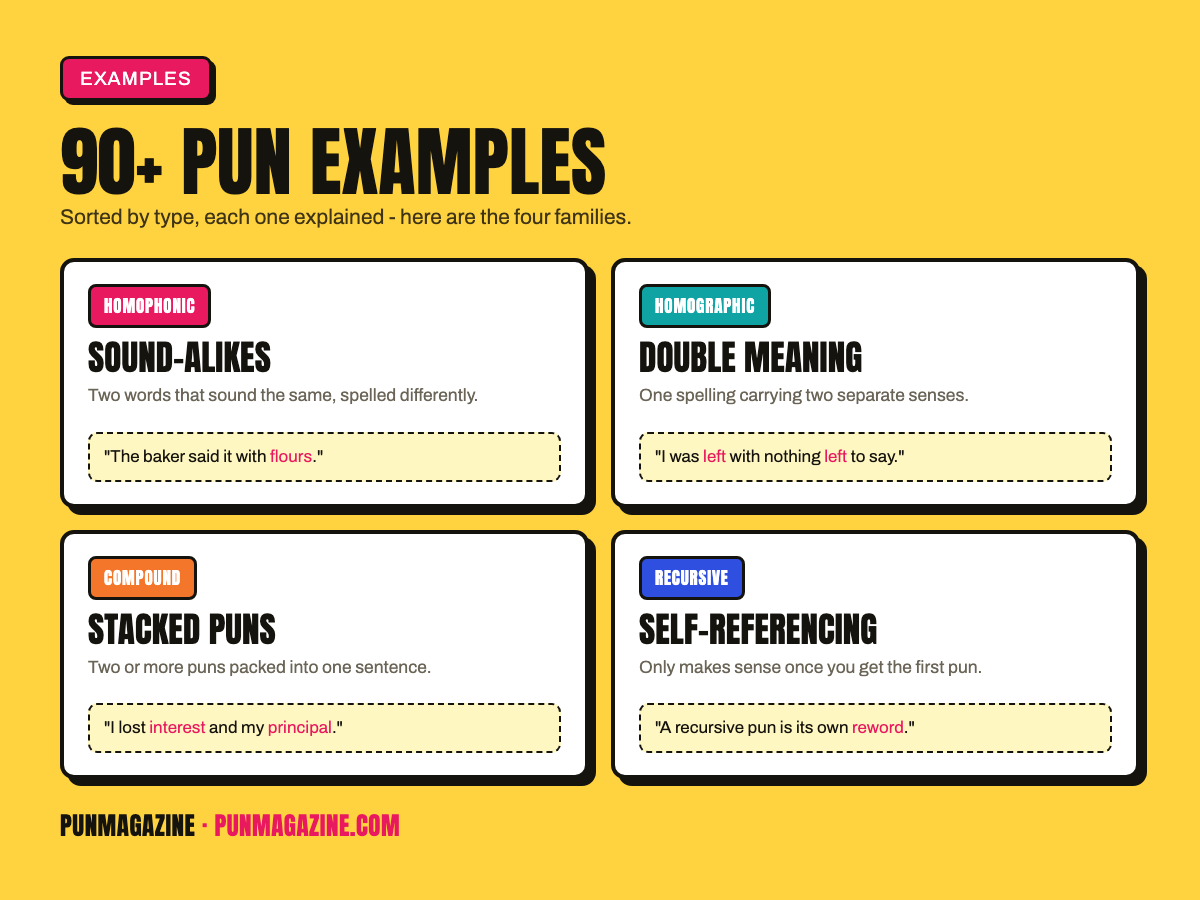
The shortest useful answer: "The baker said it with flours" is a pun. It works because flours and flowers sound identical, the phrase "say it with flowers" is already familiar, and swapping one word for its sound-twin makes the sentence describe a baker and a florist at the same time. That is the whole device in one line. Every example on this page does the same three things: it takes a word with a twin, it puts that word inside a phrase the reader already knows, and it lets both readings run at once. If a line does only one of those, it is not a pun yet. If it does all three, it is, no matter how short it is or how badly it makes you groan.
Homophonic pun examples
A homophonic pun uses two words that sound the same but are spelled differently and mean different things. These are the most common puns in English and the easiest to write, because the language is stuffed with sound-twins. Read these out loud: the joke lives in the ear, not on the page.
- "The baker said it with flours." (flour / flower)
- "A knight only ever works the night shift." (knight / night)
- "Whether the weather is fine is neither here nor there." (whether / weather)
- "The sun had a son and called him Ray." (sun / son, and ray / Ray)
- "I have been to the tailor and now I am altered." (altered / altared)
- "That fish is a real cod-father." (cod / god)
- "The cheese shop was grate." (grate / great)
- "He is a man of the cloth, so he never gets fabric-ated." (fabricated / fabric)
- "The dentist had nothing to do but fill in." (fill in / filling)
- "Our band has no drummer, so we are lacking a beat." (beat / beet)
- "She has a bad hare day every Easter." (hare / hair)
- "The gardener resigned because he could not concentrate on his own roots." (roots / routes)
Notice how many of them lean on a phrase you already know: "say it with flowers", "the night shift", "a bad hair day", "a man of the cloth". That is not a coincidence. A homophonic pun almost never works on a phrase you had to invent, because the reader needs the original in their head before you can bend it. When one of these falls flat, the usual cause is that the host phrase was not familiar enough.
Homographic pun examples
A homographic pun uses one spelling with two meanings. Nothing changes shape at all: the same word simply carries two senses and the sentence lets both fire. These read slightly cleverer than homophonic puns and land about a beat slower, because the reader has to notice a word they have already read has more work to do.
- "The dog gave a bark that matched the bark of the tree." (bark: sound / tree covering)
- "I was left with nothing left to say." (left: departed / remaining)
- "You can pull down from a duck, but you get down off a horse."
- "The watchmaker quit because he had too much time on his hands."
- "A boiled egg every morning is hard to beat."
- "I used to be a musician but I lost my band." (band: group / wristband)
- "She was fired from the calendar factory for taking a day off."
- "The scarecrow was outstanding in his field."
- "I could not work out how the seatbelt worked, then it clicked."
- "Old bankers never die, they just lose interest."
- "The maths book looked sad because it had too many problems."
- "A bicycle cannot stand on its own because it is two tired."
Homographic puns reward being read twice, which makes them the better choice for anything written down and the worse choice for anything said out loud in passing. Put them on a card, a sign or a caption where the reader controls the pace. Save the homophonic ones for speech.
Compound pun examples
A compound pun stacks two or more puns in one sentence, so the groans arrive back to back. They are harder to write and much more satisfying to land, because the first pun distracts you from the second.
- "I used to be a banker, but I lost interest and my principal." (interest, principal)
- "A man walked into a bar with a slab of tarmac under his arm and said: a pint please, and one for the road."
- "Time flies like an arrow. Fruit flies like a banana."
- "The energy vampire got a job in a power plant so he could drain the current." (drain, current)
- "Our chicken coop only has two doors. If it had four it would be a chicken sedan."
- "I tried to catch fog yesterday. Mist."
- "A backwards poet writes inverse."
- "The butcher backed into the meat grinder and got a little behind in his work."
The test for a compound pun is whether the second joke still works if you delete the first. If it does not, you have one pun with an extra word in it rather than two puns. The strongest examples above, the banker and the fruit flies, both survive that test.
Recursive pun examples
A recursive pun refers back to itself: the second half only makes sense once you have understood the first, and very often the line quietly describes what it is doing while it does it. They are rare, slightly smug, and enormously satisfying.
- "A recursive pun is its own reword." (reword / reward)
- "Infinity is not in finity."
- "A Freudian slip is when you say one thing but mean your mother."
- "I wanted to learn about palindromes, but the topic was too was too."
- "Pavlov is sitting at a bar when the phone rings. He gasps: I forgot to feed the dog."
- "There is no I in denial."
Recursive puns are the only type where explaining the joke does not entirely kill it, because half the pleasure is structural rather than verbal. They are also almost impossible to write to order. Most of the famous ones were found rather than built.
Pun examples in advertising and headlines
Advertising and the tabloid press are where puns do paid work, and both use the same trick: take a phrase the entire readership already knows and bend one word of it toward the product or the story. Newspaper sub-editors have been doing this for a century, and the best headlines are studied precisely because the wordplay carries the whole meaning. A fishmonger advertising "the sole of the city" is doing the flour and flower trick with a straight face. A gym calling itself "Planet Fitness, where you can work out your issues" is stacking a compound pun into a slogan. A locksmith trading as "Lock, Stock and Two Smoking Barrels" is borrowing a title. The pattern to copy is not the individual joke, it is the source: familiar phrase first, product word second. Reverse that order and you get the kind of strained advertising pun everybody notices and nobody repeats.
Pun examples in names
Names are the highest-traffic use of puns in ordinary life, and the constraint is brutal: one or two words, readable at a glance, and it has to still work when somebody says it down a phone line. Businesses do it constantly. Hair salons alone have produced "Curl Up and Dye", "Shear Madness", "Hair Force One" and "The Mane Event". Fish and chip shops give us "The Codfather", "A Salt and Battery" and "Frying Nemo". Pet owners do it with their own rules: a cat called Meowly Cyrus, a dog called Bark Obama, a rabbit called Hop Sing. Boats are their own category, where "Aquaholic", "Nauti Buoy" and "Ship Faced" turn up in every marina in the country.
The same three-part test applies. Is the host name familiar? Is the swapped sound close enough? Does it still read at a glance? If you want a name for a specific animal, food or job, every topic collection on this site carries a dedicated name-puns section, and the pun generator will build them from any word you give it.
Pun examples for kids
Puns written for children are not watered-down adult puns. They are built differently: the host phrase has to be one a child already knows, the second meaning has to be concrete rather than abstract, and the whole thing has to survive being retold badly at the dinner table. These are the ones that pass.
- "What do you call a sleeping dinosaur? A dino-snore."
- "Why did the teddy bear say no to pudding? He was stuffed."
- "What do you call cheese that is not yours? Nacho cheese."
- "Why did the bicycle fall over? It was two tired."
- "What do you call a fish with no eyes? A fsh."
- "How does the moon cut its hair? Eclipse it."
- "Why did the scarecrow win an award? He was outstanding in his field."
- "What do you call a bear with no teeth? A gummy bear."
Every one of those swaps a concrete noun a child can picture. None of them requires knowing an idiom about business, romance or work, which is where adult puns usually get their host phrases. If you are writing for a classroom, the clean puns collection pulls the kid-safe section out of every topic on the site.
Famous puns and where to find more
The most quoted puns in English are mostly old. Shakespeare alone is credited with thousands, and his dying Mercutio managing "ask for me tomorrow and you shall find me a grave man" is the line most often cited as proof that puns were once a mark of wit rather than a groan. That story, from Egyptian temple inscriptions through the Elizabethan stage to the modern dad joke, is covered properly in our history of the pun. For a ranked set of the strongest modern lines rather than a teaching set, see the 25 best puns of all time. And for volume on any single subject, every collection on this site holds around two hundred worked examples of its own.
How to use these examples
Read one group at a time rather than the whole page. The pattern inside a type is much easier to feel than the difference between types, and once you can hear the flour and flower trick coming you will start spotting candidates in ordinary speech. When you find one, write down the host phrase rather than the pun itself. The phrase is the reusable part: "a bad hair day" will produce a pun for hares, chairs, bears and stairs, and you only had to notice it once.

Ex-greeting-card copywriter turned full-time pun curator. Polly writes, groan-tests and reviews every list on PunMagazine - if a pun lands before you notice it, it earns its place.
More about PollyPun examples FAQ
What is an example of a pun?
"The baker said it with flours" is a pun. Flours and flowers sound identical, the phrase "say it with flowers" is already familiar, and swapping one word for its sound-twin makes the sentence describe a baker and a florist at once.
What are the four types of puns, with examples?
Homophonic uses sound-twins ("say it with flours"). Homographic uses one spelling with two meanings ("the dog gave a bark that matched the tree bark"). Compound stacks several in a line ("I lost interest and my principal"). Recursive refers back to itself ("a recursive pun is its own reword").
What is a good pun example for kids?
"What do you call a sleeping dinosaur? A dino-snore." It works because the host word is one a child already knows and the second meaning is concrete rather than abstract, which is the difference between a childrens pun and a watered-down adult one.
Can you give an example of a pun in a sentence?
Yes: "I used to be a banker, but I lost interest and my principal." Both interest and principal carry a financial meaning and an everyday one, so the sentence reads two ways at once. That makes it a compound pun, because two separate words are doing the trick.
What is the most famous pun?
Shakespeare gets the most citations, and Mercutio in Romeo and Juliet is the usual example: "ask for me tomorrow and you shall find me a grave man", turning grave from serious into tomb with his last breath.
How do I come up with my own pun examples?
Write down the host phrase rather than the pun. "A bad hair day" will produce puns for hares, bears, chairs and stairs, and you only had to notice the phrase once. The five-step method is in our guide on how to make a pun.