The History of Puns: Egypt to the Dad Joke
The pun is one of the oldest jokes we have evidence of, and for most of its life it was not considered a joke at all. It was a serious device: a way of packing two ideas into one word, used by scribes, prophets, orators and playwrights who expected their audiences to catch it. The idea that a pun is the cheapest form of humour is a comparatively recent invention, and a local one. This guide traces the device from the earliest written wordplay through the Elizabethan stage, the Victorian punning craze and the twentieth-century headline to the dad joke, and looks at how a mark of wit turned into something people apologise for. If you want the mechanics rather than the history, see <a href="/guides/what-is-a-pun">what is a pun</a>, and <a href="/guides/pun-examples">pun examples</a> for worked cases of each type.
The oldest wordplay we can read
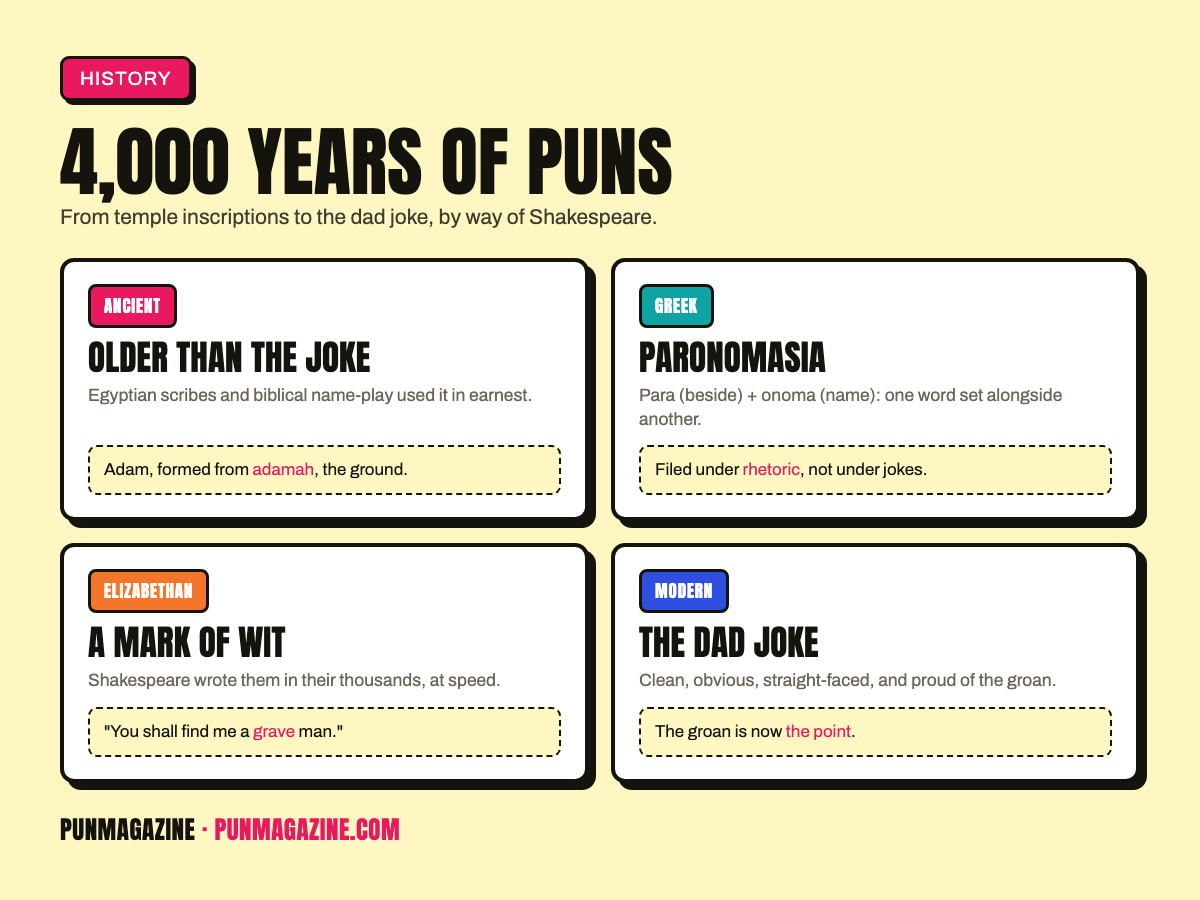
Puns appear about as early as writing does, which is less surprising than it sounds: the earliest writing systems were themselves built on sound-play. Egyptian hieroglyphs used the rebus principle, where a sign for a thing is borrowed to write a different word that merely sounds similar, and once a script works that way, deliberate punning is a very short step. Egyptian scribes buried sound-play in temple inscriptions and in the names of gods and kings, where a double meaning was not a joke but a claim: a name that also read as a blessing was understood to carry real force.
The same instinct runs through the Hebrew Bible, where puns on names do structural work rather than comic work. The first man is adam, formed from adamah, the ground. Names are changed at significant moments and the new name plays on the old. Prophetic passages turn on a single word carrying two senses at once. None of this is written to raise a laugh. It is written because a sound-link between two words was taken to indicate a real link between the two things, which is an idea about language we have largely lost and which explains why so much ancient wordplay reads as solemn rather than funny.
Greece, Rome and the naming of the thing
The Greeks gave the device its formal name. Paronomasia is built from para, meaning beside or alongside, and onoma, meaning name or word, so the term literally describes one word set alongside another, which is a neat picture of what a pun does. Greek and Roman rhetoricians catalogued it among the legitimate figures of speech, and orators used it in public argument, where a well-turned double meaning could land a point and demonstrate quickness at the same time. Cicero had a reputation for it, and for occasionally being told he overdid it. The important thing about this period is the category the pun sat in: it was filed under rhetoric, next to the other tools of persuasion, and not under jokes.
Puns in Shakespeare
The golden age of the English pun is the Elizabethan and Jacobean stage, and no one used the device more than Shakespeare. Scholars have counted them in the thousands across the plays and the sonnets, and they run the full range from broad crowd-pleasing bawdy to the kind of quiet double meaning that changes what a scene is about. Crucially, his audiences were expected to catch them at speed, in a noisy theatre, without a second reading. That tells you how normal the device was.
The single most quoted example is Mercutio's, in Romeo and Juliet. Dying from the wound that will drive the rest of the play, he tells his friends: "ask for me tomorrow and you shall find me a grave man". Grave turns from serious into tomb in the space of one word, and he makes the joke knowing exactly what it costs. It is a good demonstration of what the pun could do in this period, which is to carry weight rather than to lighten it. The wordplay is not relief from the tragedy, it is part of it.
Shakespeare also puns constantly on names, on his own included, and builds whole exchanges out of a word being passed back and forth between two senses. Hamlet's first line to Claudius turns on kin and kind. The comedies run on mistaken words the way they run on mistaken identities. For an Elizabethan audience this was a display of quick thinking, and quick thinking was prized, so the pun was closer to a virtuoso instrument than to a groan.
Puns in literature after Shakespeare
The device never left serious literature, though its reputation moved around underneath it. The metaphysical poets punned theologically, most famously John Donne playing on his own surname and on sun and son, where the double meaning is the argument rather than a decoration on it. Two centuries later Lewis Carroll made wordplay the engine of a children's book: the Mouse's tale that is also a tail, the Mock Turtle taught Reeling and Writhing, an entire logic of language behaving as though puns were the rules rather than the exceptions.
The extreme case is James Joyce. Finnegans Wake is built so densely out of puns, in several languages at once, that individual sentences can be read three or four ways without exhausting them, and the book is effectively an argument that this is what language is always doing anyway. Vladimir Nabokov punned relentlessly and in more than one language. What links these writers is that none of them treated the pun as a joke to be excused. They treated it as the most efficient way to make a word mean two things at once, which is what it is.
The Victorian punning craze
The nineteenth century is where the pun becomes a popular pastime rather than a literary device. Parlour games ran on it, after-dinner speeches ran on it, and the comic press ran on it almost entirely. Punch, founded in the 1840s, made wordplay a house style. Thomas Hood built a career on it and wrote poems whose entire structure is a sustained series of puns. Punning contests were a genuine social entertainment, with participants trading double meanings on a set topic until one of them dried up.
This is also, and not coincidentally, the period when a countervailing snobbery hardens. The more the pun became a parlour trick available to everybody, the more a certain kind of critic wanted to be seen above it. Both things are true of the Victorians at once: they punned more than any generation before or since, and they produced most of the sniffy remarks about punning that are still quoted today.
Who called it the lowest form of wit?
The line "a pun is the lowest form of wit" is quoted constantly and attributed confidently to at least four people, which is usually a sign that nobody is certain. It is commonly credited to the critic John Dennis, writing in the early eighteenth century, and that is the attribution with the strongest claim. It is also regularly assigned to Samuel Johnson, to John Dryden, and to Oscar Wilde, none of whom is a secure source for it in that form. Several versions add a second clause, "and therefore the foundation of all wit", which reverses the insult entirely and is itself of uncertain origin.
The safest thing to say is that the sentiment is genuinely eighteenth-century, that it belongs to the period when English criticism was busy separating serious writing from popular entertainment, and that the exact wording has been polished by two hundred years of repetition. It is worth knowing the attribution is shaky, because the quotation is usually deployed as though it settled something.
How the pun got its reputation
Three things happened at roughly the same time. Criticism professionalised and started policing the boundary between wit and mere cleverness. Print made wordplay cheap and ubiquitous, and anything ubiquitous loses status. And the rise of the novel shifted literary prestige toward psychological realism, where a pun tends to break the surface and remind you that you are reading. A device that had been evidence of quick thinking became evidence of trying too hard.
The habit of apologising for a pun dates from exactly this shift, which is why English has a fixed phrase for it. Our guide on no pun intended traces that disclaimer, which could only have taken hold in a culture that had already decided the joke was slightly embarrassing.
The twentieth century: headlines, adverts and the dad joke
Excluded from serious literature, the pun moved to where it was most useful, which turned out to be anywhere a message had to work in very few words. Newspaper sub-editors made it a craft. Tabloid headline writing in Britain became a genuine speciality, and its most celebrated examples are studied precisely because the wordplay carries the whole meaning of the headline. Advertising took it up for the same reason: a slogan has seconds, and a pun on a familiar phrase does the work of a sentence.
Then, in the second half of the century, the pun found its most durable modern home in the dad joke: clean, obvious, delivered with a straight face and no acknowledgement of the groan. That register is now the default way puns are performed in English, and it is a curious end point for a device that once belonged to prophets and orators. The groan is the point of it, and the person telling it knows exactly how bad the line is. See corny puns for the register in bulk.
The pun today
The device is arguably in better health now than at any point since the Victorians, because the places where puns work best have multiplied. Social media captions, usernames, business names, pet names, greeting cards, chat messages and headlines all impose the constraint the pun was built for: very little room, and a need to be memorable inside it. Cafes and hair salons have made punning shop names close to a convention. Whole comedy careers are built on it, and the annual punning competitions that the Victorians would have recognised immediately are still running.
What has genuinely changed is the delivery. A pun in 1600 was performed as a display of wit; a pun in 2026 is usually performed as a display of not caring whether it lands. The mechanism underneath is identical, and has not moved in four thousand years: take a word, find its sound-twin or its second sense, and let the two meanings collide. You can watch it happen a few hundred times over in any topic collection on this site.

Ex-greeting-card copywriter turned full-time pun curator. Polly writes, groan-tests and reviews every list on PunMagazine - if a pun lands before you notice it, it earns its place.
More about PollyA history of the pun FAQ
How old are puns?
About as old as writing. Egyptian hieroglyphs used the rebus principle, where a sign is borrowed for a word that merely sounds similar, and deliberate punning is a very short step from a script that already works that way. Puns on names also run right through the Hebrew Bible.
Did Shakespeare use puns?
Constantly. Scholars count them in the thousands across the plays and sonnets. The most quoted is Mercutio in Romeo and Juliet, dying with the line "ask for me tomorrow and you shall find me a grave man", turning grave from serious into tomb with his last breath.
Who said a pun is the lowest form of wit?
It is most often credited to the critic John Dennis in the early eighteenth century, which is the attribution with the strongest claim, but it is also assigned to Samuel Johnson, John Dryden and Oscar Wilde. None is secure. The sentiment is genuinely eighteenth-century; the exact wording has been polished by repetition.
Why did puns stop being respectable?
Criticism professionalised and began separating wit from mere cleverness, print made wordplay cheap and ubiquitous, and the rise of the novel shifted prestige toward realism, where a pun breaks the surface. A device that had shown quick thinking came to look like trying too hard.
What is the origin of the word paronomasia?
It is Greek, from para meaning beside or alongside and onoma meaning name or word. It literally describes one word set alongside another, which is a fair picture of what a pun does.
Which writers are famous for puns?
Shakespeare above all, then John Donne punning theologically, Thomas Hood making a Victorian career of it, Lewis Carroll building childrens books on it, and James Joyce whose Finnegans Wake is constructed almost entirely from multilingual wordplay.